
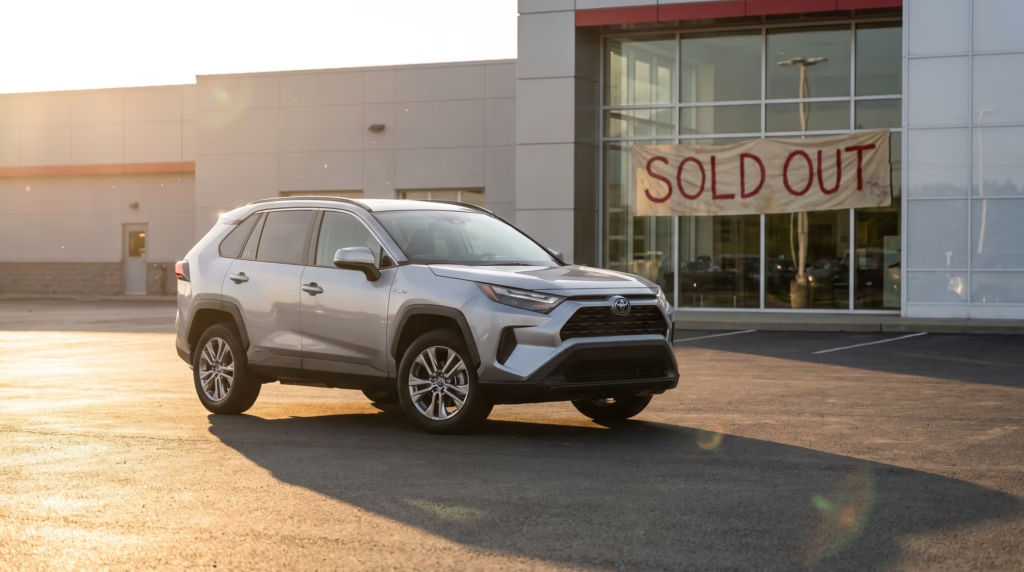
Why You Can’t Find a 2026 Toyota RAV4 Hybrid — And What to Do Instead
You walked into your local Toyota dealer ready to sign. You’d done your homework, knew your trim level, maybe even had a color in mind. Then the salesperson broke the news: no RAV4 Hybrids in stock, none incoming for weeks, and — by the way — the ones that do arrive have a $4,000 “market adjustment” on the window sticker. Sound familiar?
You’re not alone, and you’re not imagining things. The 2026 Toyota RAV4 Hybrid shortage is one of the most dramatic supply crunches the U.S. compact SUV market has seen since the chip crisis of 2021–2022. In May 2026, Toyota’s own VP of Sales publicly admitted that RAV4 turn rate hit 97.6% — meaning the company was counting inventory in hours, not the customary thirty-day supply. The result: inflated prices, frustrated buyers, and a lot of unanswered questions about when things will get better.
This guide cuts through the noise. We’ll explain exactly why the RAV4 Hybrid is so hard to find, whether dealer markups are ever worth paying, how used 2025 RAV4 Hybrid pricing compares to a new 2026, and — most importantly — which compact hybrid SUVs you can actually buy today without playing games.
Why the 2026 RAV4 Hybrid Is Sold Out: The Production Story
Featured Snippet Target: The 2026 Toyota RAV4 Hybrid shortage stems from a perfect storm: Toyota simultaneously retooled four factories in Japan, Canada, and the U.S. to produce the new all-hybrid generation, while the final gas-only 2025 models sold out faster than expected. The Kentucky plant didn’t start RAV4 production until June 2026, leaving Japan as the primary supplier for months. The result is a near-zero inventory environment where the average 2026 RAV4 sells in just 12.9 days.
The RAV4 has been America’s best-selling non-truck vehicle for years, moving nearly 480,000 units annually. So when Toyota decided to go all-in on hybrid powertrains for the 2026 model year — dropping the gas-only variant entirely from the U.S. lineup — it was a massive commitment. Every RAV4 sold in America from 2026 onward would be either a standard hybrid or a plug-in hybrid (PHEV). No exceptions.
That decision required retooling not one plant, but four: the Takaoka facility in Toyota City, Japan; Toyota’s Cambridge North and Woodstock plants in Ontario, Canada; and the Georgetown Assembly plant in Georgetown, Kentucky. These staggered changeovers meant that production of the new model trickled in slowly — Japan came online in December 2025, Canada in January 2026, but Kentucky didn’t start building 2026 RAV4 Hybrids until this month.
Meanwhile, buyers panic-bought the outgoing 2025 model. Because the 2025 RAV4 was the last gas-only version available in the U.S., it carried unusual end-of-era appeal. Toyota didn’t even need to offer discounts — the 2025 RAV4 sold out anyway, with zero incentives. By February 2026, RAV4 inventories had dropped over 51% year-over-year. The 2025 PHEV version essentially vanished from dealer lots entirely.
The 2026s that do arrive don’t stick around. As of February 2026, the average 2026 RAV4 was spending just 12.9 days on a dealer lot before being sold — compared to 50 days for the remaining 2025 gas models. RAV4 sales are running roughly 40% below last year’s pace through May 2026, a direct consequence of the supply crunch rather than any drop in consumer interest.
Toyota invested $1 billion into its Kentucky facility as part of a broader $10 billion U.S. manufacturing commitment, with $800 million specifically earmarked to boost RAV4 and Camry Hybrid production capacity. An expansion is also planned for 2027. The infrastructure is being put in place — but for now, buyers are in a waiting game.
To understand how this hybrid shift fits into the broader electrification movement, our analysis of the hybrid vs. EV market battle in 2026 provides useful context on why automakers like Toyota are betting on hybrids over full EVs right now.
Dealer Markups on the 2026 RAV4 Hybrid: Are They Worth Paying?
Short answer: almost certainly not. But let’s walk through the numbers so you can make an informed call.
The 2026 RAV4 Hybrid starts at $33,350 including destination — that’s $2,100 more than the base 2025 gas RAV4, but actually $950 cheaper than the equivalent 2025 RAV4 Hybrid. On paper, the value proposition is reasonable. The problem is what dealers are layering on top.
Average 2026 RAV4 listings on Cars.com sit around $43,000 nationally — roughly $71 above MSRP on the mild end. But at high-demand markets, the markups are eye-watering. Capitol Toyota in San Jose, California is reportedly adding $5,995 in dealer markup, turning even the base LE trim into a nearly $40,000 vehicle. Stevens Creek Toyota in the same area is adding $4,995 to each of 38 listed vehicles. One Reddit user reported a $1,400 “Tariff Adjustment” tacked on at the last moment — a label that industry experts say has no legitimate basis given that both the 2025 and 2026 RAV4 are built in North America.
Torque News reports some showrooms are showing average transactional prices $4,200 above MSRP. CarEdge’s market analysts have documented premium “market adjustment” fees in the $3,000–$7,000 range on hybrid trims, with RAV4 Prime plug-in hybrid models seeing markups of $8,000–$10,000 in some markets — pushing them toward $60,000.
KEY TAKEAWAY: Dealer Markups A markup is dealer profit, plain and simple. There is no economic reason to pay $5,000 over MSRP for a vehicle that will soon be widely available. As Kentucky production ramps through Q3 2026, inventory will build and markups will fade — exactly as they did with the RAV4 Hybrid in 2023–2024. If you must have one now, limit yourself to $1,000–$2,000 over MSRP maximum, expand your dealer search radius, and avoid mandatory add-on accessories packages. Dealers in lower-demand markets (Midwest, rural areas) are already discounting — Minot Toyota in North Dakota was offering $500 off in February 2026.
Used 2025 RAV4 Hybrid vs. New 2026: Which Is the Better Buy?
If you’re weighing a used 2025 against a new 2026, the math is trickier than it looks.
New 2025 RAV4 Hybrids have sold out from dealerships. To get one, you’re shopping the used market — and because demand remains strong, prices for certified-pre-owned and private-sale 2025 RAV4 Hybrids haven’t dropped the way you’d normally expect from a year-old vehicle. Average 2025 RAV4 Hybrid listings hovered just under $37,000 earlier this year with only about $1,000 in average discounts. For a lightly used example with 10,000–15,000 miles, expect to pay somewhere in the $35,000–$38,000 range depending on trim and market.
Meanwhile, the 2026 RAV4 Hybrid — if you can get one at MSRP — starts at $33,350 and carries a genuinely improved feature set: better fuel economy (up to 44 mpg combined on FWD models), refreshed styling, a standard Toyota Drive Recorder dash-cam system, Apple CarKey and Samsung Digital Key support, and a standard 12.3-inch touchscreen. The 2026 also benefits from Toyota’s latest hybrid powertrain refinements.
| Metric | Used 2025 RAV4 Hybrid | New 2026 RAV4 Hybrid |
|---|---|---|
| Price Range | ~$35,000–$38,000 | $33,350 MSRP (+ markup risk) |
| Fuel Economy (AWD) | ~38 mpg combined | 42 mpg combined |
| Warranty Remaining | Partial (age/mileage dependent) | Full Toyota factory warranty |
| Tech / Features | Previous gen infotainment | 12.3″ screen, Apple CarKey, Drive Recorder |
| Availability | Limited used market supply | Extremely tight new inventory |
| Gas-only option? | Yes (gas trim available) | No — hybrid only |
The bottom line: if you can secure a 2026 at or near MSRP, it’s the better car at a lower effective price. But if dealer markups are $4,000+, a lightly used 2025 RAV4 Hybrid with full service history starts to make financial sense. Just be wary of private sellers who’ve caught on to the supply crunch and priced accordingly.
Best Alternatives to the 2026 Toyota RAV4 Hybrid You Can Buy Right Now
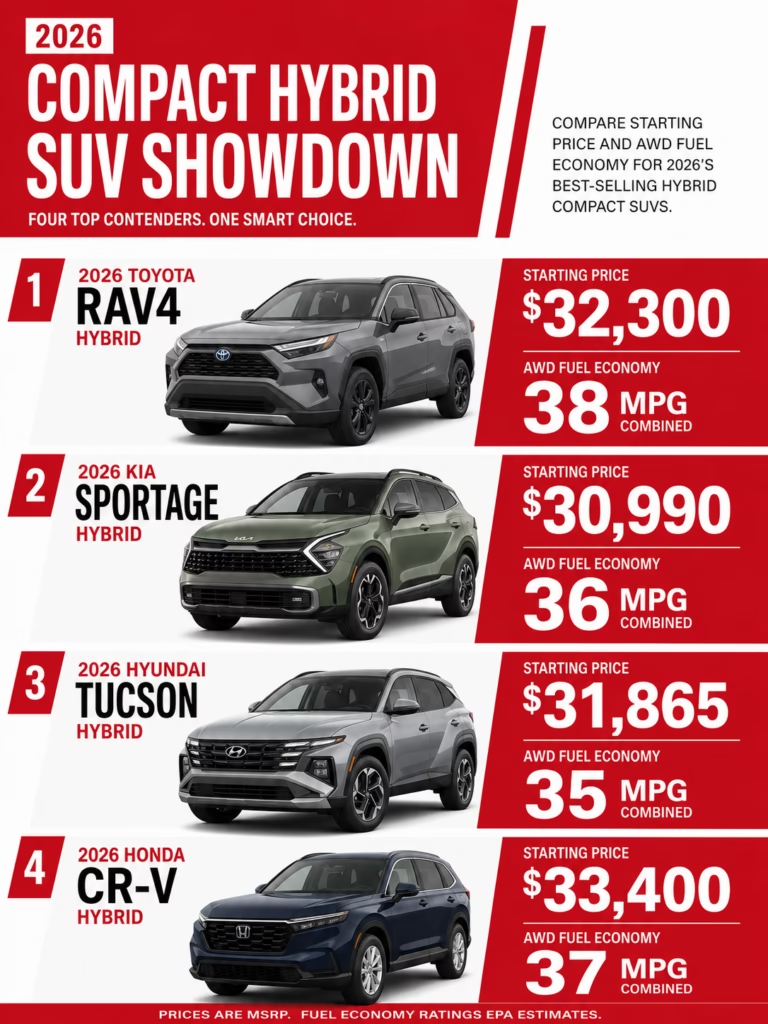
Here’s the important thing: the RAV4 Hybrid shortage hasn’t happened in a vacuum. Its three closest competitors — the Honda CR-V Hybrid, Hyundai Tucson Hybrid, and Kia Sportage Hybrid — have all been refreshed for 2026 and are sitting on dealer lots at or near MSRP. You don’t have to wait, and you don’t have to overpay.
Kia Sportage Hybrid — Best Overall Value
In a head-to-head comparison by Edmunds that included all three rivals, the Kia Sportage Hybrid came out on top. Updated for 2026 with a freshened cabin and improved technology, the Sportage Hybrid starts at just $30,290 for the base LX — nearly $3,000 less than the RAV4 Hybrid’s MSRP. The top SX-Prestige trim at $40,390 undercuts the similarly equipped CR-V Sport Touring by roughly $2,000, yet comes loaded with a standard 12.3-inch touchscreen, ventilated front seats, and a surround-view camera. Kia also backs the Sportage Hybrid with its class-leading 5-year/60,000-mile basic and 10-year/100,000-mile powertrain warranties. Fuel economy on AWD models is rated at 35 mpg combined — lower than the RAV4’s 42, but the purchase price savings often offset that gap over a typical ownership cycle.
Hyundai Tucson Hybrid — Best Standard AWD Value
The Tucson Hybrid enters 2026 with a new Blue SE entry trim that drops the base price to $32,200 — and every single trim includes standard AWD. That’s a meaningful advantage over both the CR-V and RAV4, where AWD costs extra. U.S. News & World Report currently ranks the Tucson Hybrid ahead of the CR-V Hybrid in its category, praising its near-luxury interior quality following the 2026 refresh. The top Limited trim starts at $41,825. Like its Kia sibling, the Tucson Hybrid offers a 10-year/100,000-mile hybrid battery warranty and a lifetime battery warranty for the original owner — coverage that neither Toyota nor Honda comes close to matching.
Honda CR-V Hybrid — Best to Drive
If driving dynamics matter to you, the CR-V Hybrid is the clear pick. Edmunds’ testers called it the best-handling vehicle in the segment by a meaningful margin, praising its responsive powertrain and athletic suspension. The 2026 model gained standard wireless Apple CarPlay and Android Auto across all trims, and a new TrailSport variant ($40,250) targets buyers who want mild off-road capability. The CR-V Hybrid’s base Sport trim starts at $35,630 — the most expensive entry point in this group — and tops out at $42,250 for the Sport Touring. Cargo space is the best in the class at 71.8 cubic feet with the rear seats folded. The main drawback: Google built-in is limited to the top trim, and there’s no panoramic sunroof option. Fuel economy at 37 mpg combined (AWD) is solid but trails the RAV4.
| Vehicle | Base Price | AWD | MPG (AWD) | Warranty (Powertrain) | Availability |
|---|---|---|---|---|---|
| 2026 Toyota RAV4 Hybrid | $33,350 | Optional | 42 mpg | 5yr/60K mi | ⚠️ Very Tight |
| 2026 Kia Sportage Hybrid | $30,290 | Optional ($32,590+) | 35 mpg | 10yr/100K mi | ✅ Good |
| 2026 Hyundai Tucson Hybrid | $32,200 | Standard (all trims) | ~38 mpg | 10yr/100K mi | ✅ Good |
| 2026 Honda CR-V Hybrid | $35,630 | Optional | 37 mpg | 5yr/60K mi | ✅ Good |
If you’ve been exploring the compact hybrid SUV class, our coverage of high-value SUVs worth paying a premium for offers broader context on how to evaluate capability versus cost across different vehicle categories.
When Will 2026 RAV4 Hybrid Supply Normalize?
The honest answer is: late 2026 at the earliest, with meaningful improvement expected in early 2027.
Here’s the production trajectory as it stands today. Japan’s Takaoka plant has been running since December 2025. Toyota’s Canadian facilities in Cambridge and Woodstock came online in January 2026, handling the majority of U.S.-bound supply. Most importantly, the Georgetown, Kentucky plant — which employs nearly 10,000 workers and has produced 15 million vehicles since opening — formally began 2026 RAV4 Hybrid production this month (June 2026). Kentucky is expected to contribute approximately 40,000 RAV4 units in 2026, with a further capacity expansion planned for 2027.
Toyota has invested a cumulative $2 billion in the Georgetown facility over the past two years, and the plant is also set to launch production of a Highlander Battery Electric Vehicle in September 2026. The infrastructure investment is real, and it signals that Toyota is treating the Kentucky plant as a cornerstone of its North American electrification strategy.
Kelley Blue Book, which awarded the 2026 RAV4 its Best Buy designation, noted that RAV4 sales are running down roughly 40% through May 2026 — not because of lack of demand, but purely because of restricted supply. Every analyst covering the story agrees that once Kentucky hits full stride, the RAV4 will reassert itself as the dominant compact hybrid SUV. The question is simply timing.
For buyers who can wait, Q4 2026 is when the first real signs of inventory relief should appear. Markups will likely compress significantly by then. For buyers who need a vehicle now, the three alternatives above represent genuinely excellent choices — not consolation prizes.
For a deeper look at how affordable hybrid options have expanded across price points, our guide to budget-friendly hybrid vehicles covers some strong sub-$35,000 options across the market right now.
People Also Ask: Your RAV4 Hybrid Questions Answered
Why is the 2026 Toyota RAV4 Hybrid so hard to find?
Toyota had to retool four factories simultaneously to produce the new all-hybrid 2026 RAV4. Production started in Japan in December 2025, Canada in January 2026, and Kentucky only in June 2026. That sequential ramp-up created a massive supply gap at dealerships — while demand for the final gas-only 2025 model simultaneously accelerated and wiped out old inventory. The result is one of the tightest supply situations in the compact SUV segment in years.
Are dealer markups on the 2026 RAV4 Hybrid worth paying?
In most cases, no. Markups of $3,000–$6,000 above MSRP are common, and some California dealers are charging nearly $6,000 over sticker. As Kentucky production ramps up through Q3 2026, inventory will improve and markups will fade. Patience or a broader dealer search radius (even crossing state lines) is usually the smarter financial move.
When will 2026 RAV4 Hybrid inventory normalize?
Toyota’s Georgetown, Kentucky plant began RAV4 Hybrid production in June 2026, adding an estimated 40,000 units this year alone. Combined with Canadian and Japanese output, market analysts expect inventory to meaningfully improve by Q4 2026, with near-normal supply expected in early 2027.
What is the best alternative to the 2026 Toyota RAV4 Hybrid right now?
The Kia Sportage Hybrid wins most expert comparisons for overall value, starting at $30,290 with a 10-year/100,000-mile powertrain warranty. For buyers wanting standard AWD on every trim, the Hyundai Tucson Hybrid at $32,200 is the strongest pick. Those prioritizing driving dynamics should consider the Honda CR-V Hybrid, which starts at $35,630 and offers the best handling in the segment.
Is the 2025 RAV4 Hybrid still available to buy?
New 2025 RAV4 Hybrids have effectively sold out from dealerships nationwide. Used examples exist on the secondary market, but demand has kept prices elevated. Expect to pay close to or above original MSRP for a low-mileage used 2025 RAV4 Hybrid in mid-2026, which undermines much of the usual used-car value proposition.
Looking Ahead: The RAV4 Hybrid’s Road Back to Normal
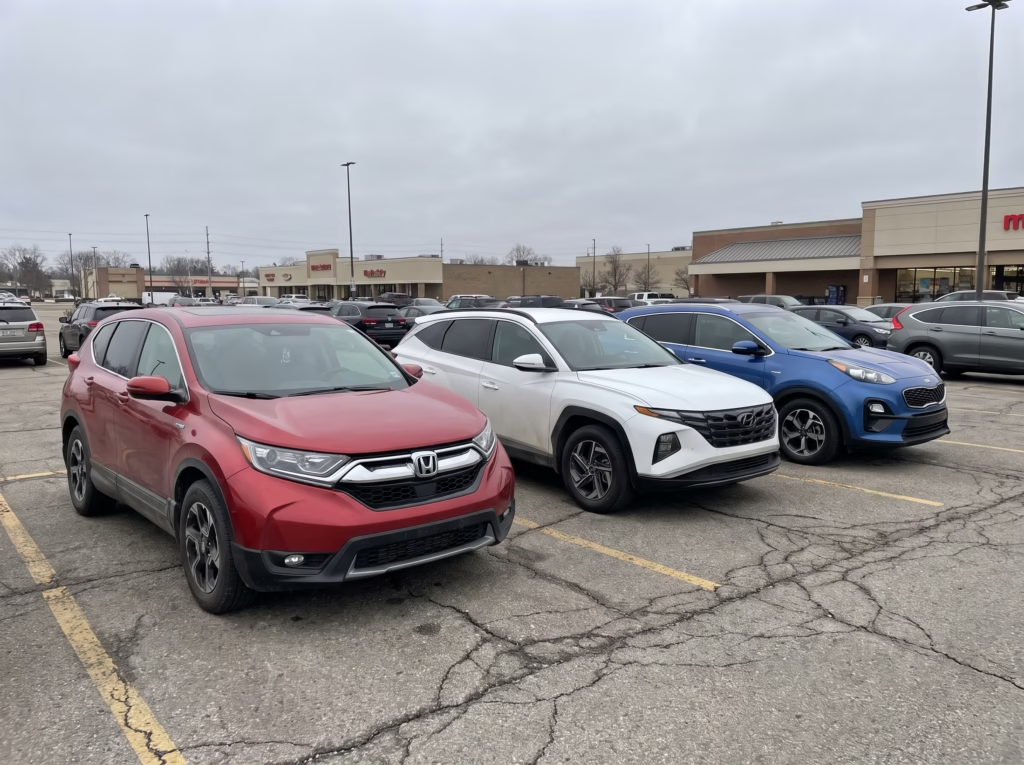
The 2026 RAV4 Hybrid shortage isn’t a mystery, and it isn’t a permanent condition. It’s the predictable friction of a major generational changeover — amplified by the scale of Toyota’s ambition in going fully hybrid on its bestselling model. Four plants don’t retool overnight, and a vehicle that moves half a million units per year doesn’t restock in weeks.
What comes next: Kentucky adds 40,000 units in 2026, with more capacity coming in 2027. The RAV4 PHEV, currently absent from U.S. dealers entirely, is expected to arrive later in 2026 with Japanese-sourced production. Toyota’s $1 billion Kentucky investment, once fully operational, gives the company the U.S. manufacturing backbone to sustain RAV4 Hybrid demand for years to come.
For the patient buyer who specifically wants a 2026 RAV4 Hybrid: wait until Q4 2026 or early 2027, target dealers outside major metro areas, and don’t pay a dollar above MSRP. Supply always catches up to demand — and with the Kentucky plant now running, the timeline is clearer than it’s been all year.
Final Verdict: Don’t Panic. Do Your Math.
The 2026 Toyota RAV4 Hybrid is a genuinely excellent compact SUV. But right now, “excellent” comes with asterisks: limited availability, aggressive dealer markups, and a wait that could stretch months. If you need a hybrid crossover today, the Kia Sportage Hybrid, Hyundai Tucson Hybrid, and Honda CR-V Hybrid are all compelling in their own right — and available at fair prices. If you can wait, Q4 2026 should bring relief. Either way, paying $5,000 over sticker for the privilege of not waiting is rarely the smart play.
Drive what you can get at a fair price. The RAV4 will still be there when supply catches up — and so will its legendary resale value.

Saikat has been obsessed with cars since he was old enough to recognise the difference between a hatchback and a saloon. With years of experience researching, writing, and living the automotive world, he covers everything from supercar engineering and motorsport history to EV technology and concept car design.
His writing style is direct, enthusiastic, and grounded in real research — no fluff, no filler. When he’s not writing about cars, he’s probably reading about them.