The Hybrid Takeover: Why the World Is Falling Out of Love with Pure EVs in 2026
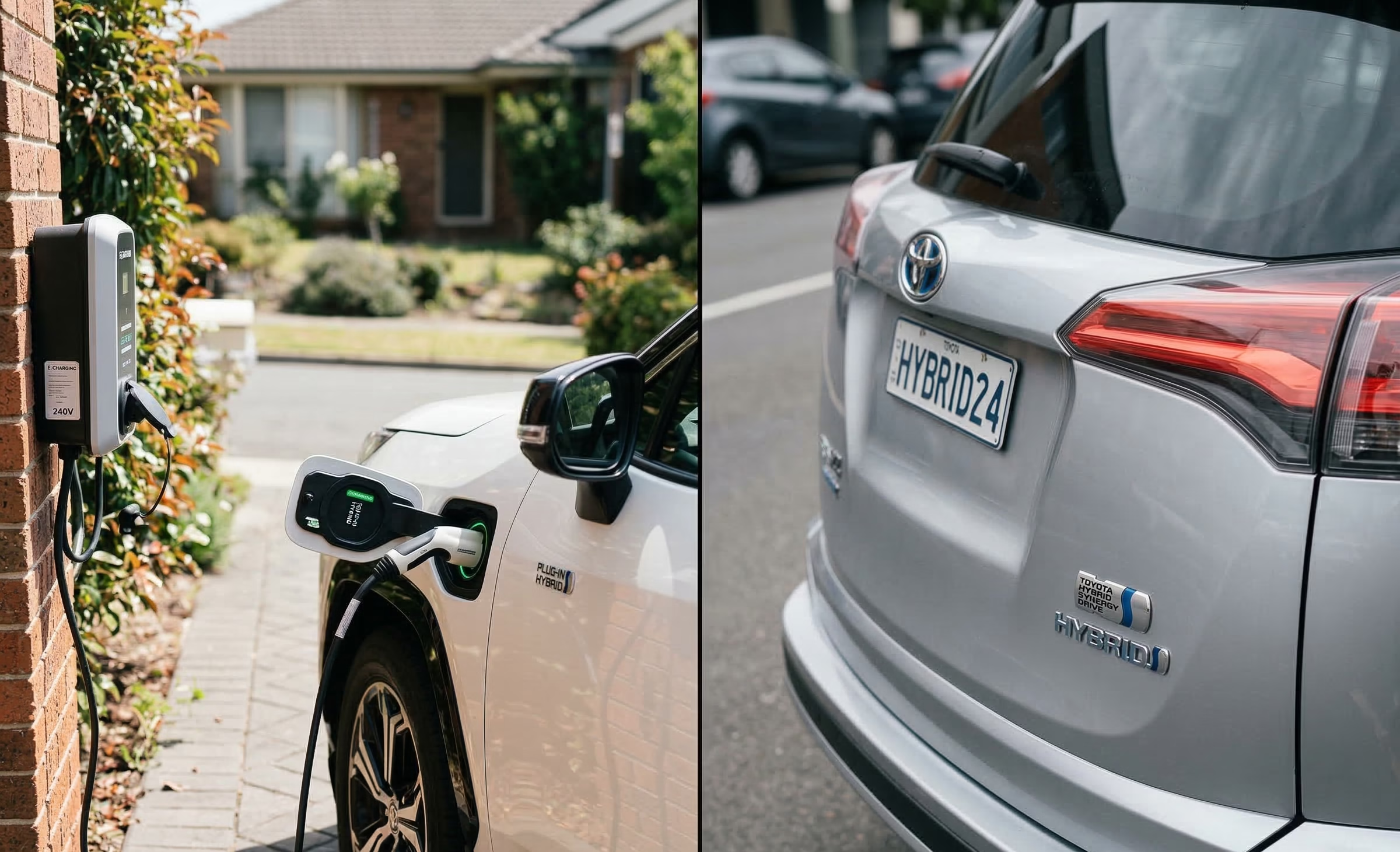
Remember when the auto industry was racing full-speed toward an all-electric future? Automakers were pledging EV-only lineups by 2030. Governments were dangling thousands of dollars in tax credits. The narrative was clear: internal combustion was dead, and battery electric vehicles were the only destination worth talking about.
That story has gotten a lot more complicated.
In 2026, the world’s biggest auto markets are telling a very different tale — one where tariffs, crumbling incentives, and honest consumer feedback are forcing a major course correction. The big winner? The humble hybrid. And the question every car buyer is now asking isn’t “EV or gas?” — it’s “why isn’t anyone talking about hybrids more?”
Let’s break down what’s actually happening, market by market, and what it means if you’re in the market for a new car right now.
The Great EV Slowdown: What Changed?
It wasn’t one thing. It was everything hitting at once.
In the United States, the federal $7,500 EV tax credit that had propped up demand for years quietly expired in late 2025. At the same time, the Trump administration imposed sweeping tariffs — initially 25% on imported vehicles and parts, later adjusted to around 15% for some trading partners — that pushed production costs significantly higher. Automakers who had bet heavily on electrification were suddenly staring at a market where consumer appetite for pure battery electric vehicles had cooled noticeably.
The numbers tell the story. According to Cox Automotive, plug-in hybrid vehicles (PHEVs) are projected to jump from just 8% to 19% of all electrified vehicle sales in the US in 2026 — almost entirely coming at the expense of pure BEVs. Meanwhile, hybrid registrations in the US surged to 13.6% market share in early 2025, up from 11.3% the year before. By the end of 2024, hybrids already accounted for roughly 60% of all electrified vehicle sales in the country.
That’s not a blip. That’s a structural shift.
But here’s what makes 2026 genuinely fascinating: it’s not playing out the same way everywhere. Across the US, UK, Europe, China, and India, the hybrid-vs-EV tension is being shaped by wildly different local forces. Let’s look at each one.
United States: Tariffs, Sticker Shock, and the PHEV Boom
If you walk into a US dealership right now, you’ll notice something strange: waitlists for PHEVs that didn’t exist a year ago.
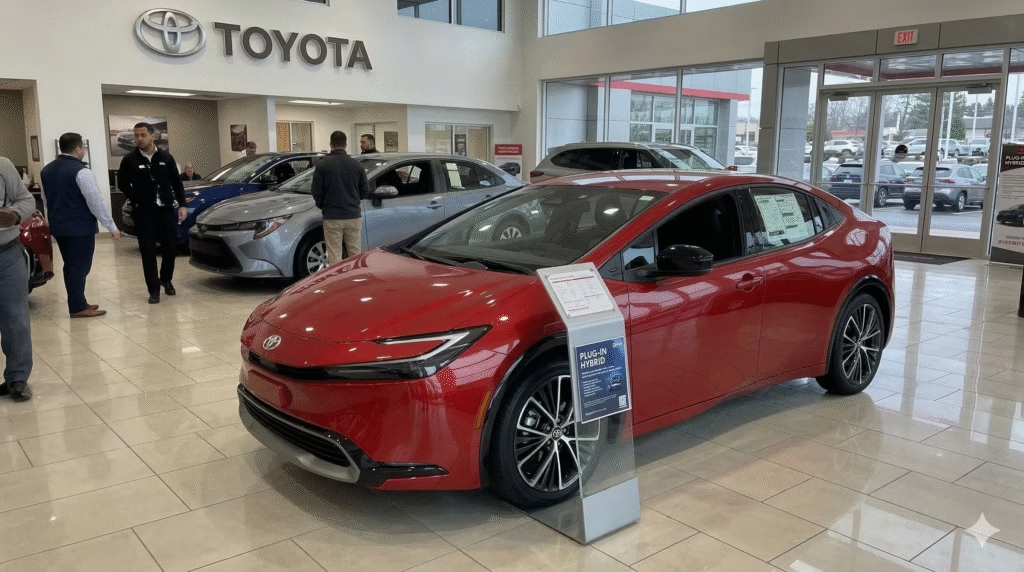
The Ram 1500 Ramcharger reportedly received 87,000 reservations in just 72 hours after tariff news broke. Jeep Wrangler 4xe waitlists have stretched out to 9–12 months. Toyota dealers say they simply can’t build Prius Primes fast enough to meet demand. Meanwhile, several Hyundai and Kia stores are discounting pure BEV models by $9,000–$12,000 to clear lots.
The reason is straightforward: most new PHEVs still qualify for the full $7,500 federal tax credit through 2032 under existing legislation. Their smaller battery packs (typically 15–30 kWh versus 60–100+ kWh for pure EVs) mean minimal exposure to battery-related tariff costs. And the gas backup eliminates range anxiety — which, let’s be honest, remains the biggest psychological hurdle for mainstream buyers.
General Motors, which had invested billions in its Ultium EV platform, reported a 57% tumble in Q3 net income in 2025, with tariffs costing the company $1.1 billion in a single quarter. Ford, not long after, announced a sweeping pivot away from pure EVs toward extended-range hybrids and smaller, more affordable electric models. Its CEO Jim Farley called it “a customer-driven shift.”
Toyota, for its part, is quietly having a moment. The world’s largest automaker sold a record 11.3 million vehicles globally in 2025, and its hybrid-heavy lineup has proven remarkably resilient. Even as tariffs cost the company roughly $8 billion in operating profit for its fiscal year, Toyota raised its full-year profit forecast — a testament to the staying power of a strategy the company was mocked for just a few years ago.
What US buyers should know: If you’re considering an EV purchase, the used EV market is genuinely interesting right now. The price gap between used EVs and used gas cars narrowed to just $897 on average in late 2025 — the smallest spread ever recorded. But for new vehicles, PHEVs offer the best of both worlds, especially while the tax credit window remains open.
9 Incredible new ways to charge your electric vehicle
United Kingdom: Navigating the Transition Period
The UK is in a peculiar position. The government has committed to phasing out new pure petrol and diesel car sales by 2035, and automakers selling into the UK market face Zero Emission Vehicle (ZEV) mandates requiring a growing percentage of their sales to be electric.
But consumers aren’t entirely cooperating.
The 2026 Deloitte Global Automotive Consumer Study found that respondents across several global markets — including the UK — cited driving range, charging time, lack of public charging infrastructure, and battery-related costs as their top concerns about EVs. These aren’t new worries. What’s new is that automakers are finally being forced to listen.
The collapse of Jaguar Land Rover’s EV ambitions was a cautionary tale close to home. A major cyberattack on JLR in 2025 caused an estimated £1.9 billion in damage and affected more than 5,000 UK organizations — a stark reminder that the digital transformation of vehicles carries new vulnerabilities. It also distracted the company at a critical moment of product transition.
For UK buyers, the practical reality is that hybrids and PHEVs offer a sensible middle ground during what is clearly a transition period. The public charging network is improving but remains uneven, particularly outside major cities. A PHEV lets drivers go electric for daily commutes — the average UK commute is well within most PHEV electric ranges — while retaining the flexibility of petrol for longer journeys.
Europe: Chinese Pressure, Regulatory Tension, and the Diesel Hangover
Europe’s auto market is arguably under more stress than any other major region in 2026. It’s getting squeezed from two directions simultaneously.
From inside, European automakers are wrestling with the final decline of diesel — once the continent’s dominant powertrain — while scrambling to meet increasingly stringent CO₂ regulations. BEV prices in Europe are declining faster than expected, but that’s partly because Chinese manufacturers are flooding the market with competitively priced electric models, targeting higher-margin segments with aggressive pricing. Traditional European brands are now in the uncomfortable position of raising prices on ICE models to partially subsidize BEV discounts — a strategy that has real limits.
From outside, the tariff situation has created a complex patchwork. The EU has been working to finalize tariff reductions on car exports to the United States, with reports suggesting a potential agreement that would reduce the current 27.5% tariff on European cars to 15% — but only once the EU introduces reciprocal legislation on US goods.
Chinese automakers, meanwhile, aren’t standing still. S&P Global Mobility forecasts that global vehicle production share for Chinese-origin brands will rise to roughly 27.4% in 2026. BYD continues to deepen its European presence, and Chinese suppliers are rapidly closing the gap in advanced chassis technologies like steer-by-wire and brake-by-wire systems.
European production is expected to edge down slightly to around 14 million units in 2026 — modest, but reflecting a market in genuine flux rather than freefall.
For European buyers: The good news is that increased competition is pushing prices down on EVs. The bad news is that entry-level affordable EVs remain scarce from traditional European brands. Chinese options are increasingly viable on price, but lingering questions about long-term software support and after-sales service are legitimate considerations for buyers thinking about ownership costs over 5–7 years.
China: The Price War Is Over — What Comes Next?
China has been the world’s most fascinating automotive experiment for the past three years. The sheer aggression of its domestic EV market — dozens of competing brands, relentless price cuts, government subsidies — pushed the country to EV adoption levels that left Western markets far behind.
But in February 2026, China officially ended its domestic EV price war, after the industry absorbed an estimated $68 billion in losses. That’s a staggering number, and it signals the end of one era and the beginning of another.
The next phase for Chinese automakers is premiumization. As S&P Global Mobility noted, Chinese brands are now diversifying their pricing strategies — cutting prices to capture volume at the low end while successfully introducing higher-priced, tech-enhanced models for buyers willing to pay for features like AI-driven personalization, voice command systems in local languages, and over-the-air software updates.
China’s domestic sales are expected to slip by about 267,000 units in 2026 as post-incentive demand softens and economic growth moderates. But export volumes are growing: Chinese automakers produced about 1.1 million vehicles outside mainland China in 2025, and that figure is expected to rise to roughly 1.6 million in 2026. Their targets? Europe, Latin America, Southeast Asia, and increasingly, India.
The Deloitte study found a telling cultural difference: in China (and India), consumers increasingly view the in-vehicle digital ecosystem as more important than their smartphone. That’s shaping what features Chinese automakers build — and explains why they’re increasingly competitive in digital-first markets.
India: The Quiet Outperformer
India doesn’t get the headlines that China, the US, or Europe do in automotive coverage. It should.
India is the only major auto market where sales growth is genuinely expected to accelerate in 2026, with an additional 400,000 units forecast — a 5.3% regional increase. The country’s combination of a growing middle class, government EV incentives, and a competitive domestic manufacturing base (Tata Motors, Mahindra, Maruti Suzuki) makes it one of the more interesting markets to watch.
The dynamics here are different from elsewhere. Affordability is paramount — the average transaction price in India is a fraction of what buyers pay in the US or Europe. Chinese manufacturers, particularly BYD, are eying India as a key growth market, though they face geopolitical friction and local manufacturing requirements.
Consumer preferences are also distinctly local. QR code-based digital payments are the preferred payment method (versus smartphone apps in China). Interest in buying vehicles directly from manufacturers — bypassing dealers — is significantly higher in India than in Western markets. And voice command support in local languages is considered a critical feature by Indian consumers in ways that Western buyers simply don’t prioritize.
For the global automotive industry, India represents something valuable and rare in 2026: genuine organic growth.

What the Data Is Actually Telling Us
Step back from the individual markets, and a few clear patterns emerge.
First, the EV transition is real but slower than the industry planned for. Global BEV sales are still growing — from an estimated 14.7 million units in 2025 to a projected 17.4 million in 2026. But the pace is well below earlier projections, and the US market in particular has plateaued.
Second, hybrids are having their vindication moment. Toyota was widely criticized for its cautious approach to pure EVs. In 2026, that caution looks remarkably prescient. The hybrid powertrain — which Toyota has been refining for nearly 30 years — turns out to be exactly what mainstream buyers want during a transition period marked by infrastructure gaps and price uncertainty.
Third, Chinese automakers are becoming a genuinely global competitive force. They’re not just selling cheap cars anymore. They’re closing technological gaps in areas from solid-state batteries (the “solid-state arms race” continues, per industry analysts) to advanced chassis systems and in-vehicle digital experiences.
Fourth, tariffs are the wild card that nobody can fully price in. The US tariff environment has shifted multiple times in the past 18 months, and further changes — via trade negotiations, legal challenges, or Congressional action — remain entirely possible. Automakers are trying to build supply chains that can absorb shocks. Buyers are making decisions under genuine uncertainty.
So What Should You Do If You’re Buying a Car Right Now?
Here’s the honest answer: it depends heavily on where you live and what you’re buying for.
If you’re in the US and considering electrification, the PHEV sweet spot is real right now. Models that qualify for the full $7,500 tax credit, have smaller battery packs shielded from tariff exposure, and offer genuine electric range for daily driving are the rational choice for most buyers. The used EV market also offers historically good value if you’re open to it.
If you’re in the UK or Europe, the charging infrastructure situation is genuinely improving, and BEV prices are falling — but the gap between urban and rural charging availability remains meaningful. Unless you have reliable home charging, a hybrid remains the safer bet for everyday peace of mind.
If you’re in China, you’re living in the world’s most competitive EV market, with more model choices and better prices than anywhere else. The end of the price war means prices may stabilize — so the extraordinary deals of 2024–2025 may not persist.
If you’re in India, watch the next 24 months carefully. The market is evolving fast, local EV options are improving, and the government’s policy support for electric vehicles is creating real momentum — particularly in two-wheelers and smaller passenger cars.
What’s Coming Next
The second half of 2026 will be shaped by a handful of developments worth watching closely:
- USMCA renegotiation: The upcoming review of the US-Mexico-Canada trade agreement could significantly reshape where North American vehicles are made and what they cost.
- Solid-state battery commercialization: Multiple manufacturers are moving beyond pilot lines toward larger-scale production. If costs come down as expected, the calculus for pure EVs shifts significantly by 2028–2030.
- Chinese export growth: As Chinese manufacturers deepen their global footprint, traditional OEMs in Europe and India face intensifying competition that will force pricing and feature responses.
- Semiconductor supply: A looming DRAM shortage — as AI data center demand competes with automotive needs — could trigger supply disruptions and price spikes of 70–100% for automotive-grade chips.
The automotive industry is rarely boring. In 2026, it’s genuinely thrilling — and a little bit terrifying — depending on which side of the industry you’re on.
One thing is clear: the era of a simple, linear march toward pure electric vehicles is over. What’s replacing it is messier, more regional, and ultimately more consumer-driven. That might not be the clean narrative the industry wanted. But it’s probably the right one.
SOURCING NOTES

Saikat has been obsessed with cars since he was old enough to recognise the difference between a hatchback and a saloon. With years of experience researching, writing, and living the automotive world, he covers everything from supercar engineering and motorsport history to EV technology and concept car design.
His writing style is direct, enthusiastic, and grounded in real research — no fluff, no filler. When he’s not writing about cars, he’s probably reading about them.